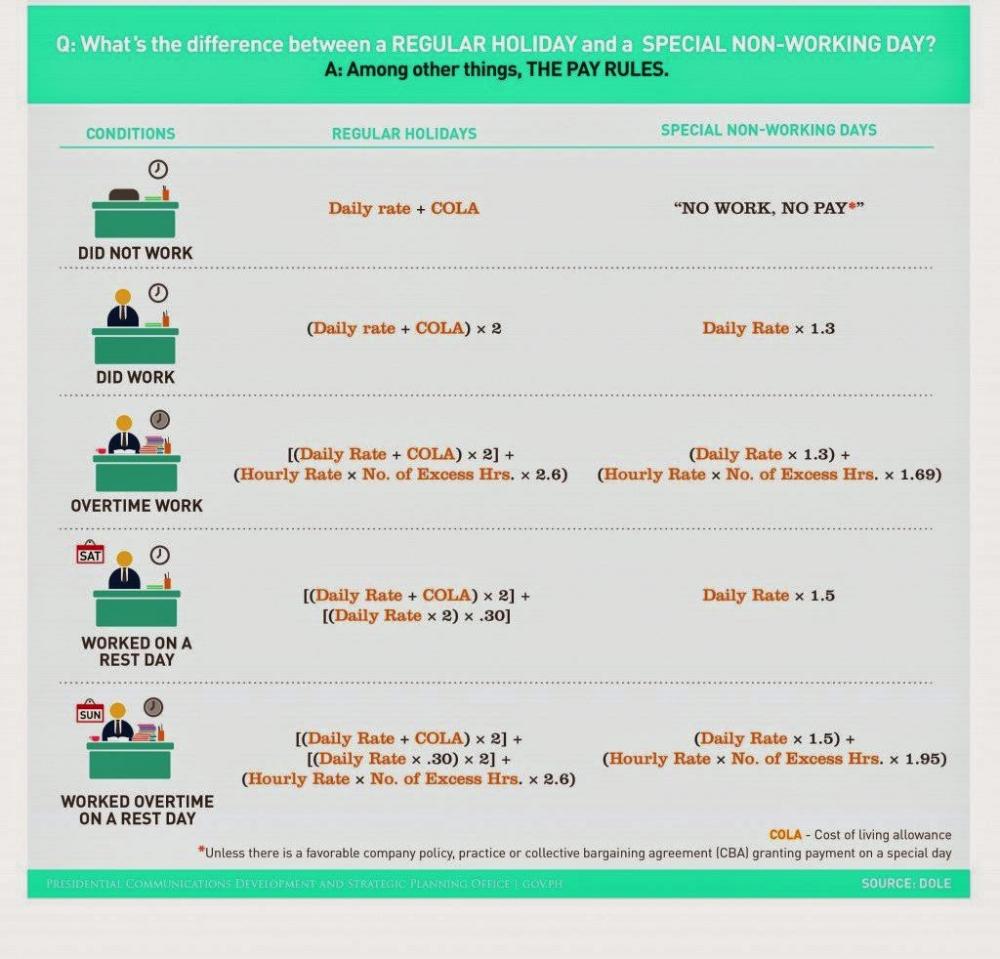
I found this while browsing through my Twitter list.
Note the pay rules for each.
Check out the original tweet by the Official Gazette PH.
Lawyer | Law Professor | Author
I found this while browsing through my Twitter list.
Check out the original tweet by the Official Gazette PH.
Madelyn narrated that in April 2010, the school engaged her as a releasing clerk in its book sale, tasking her with the inventory and release of books to the school’s students.
In July 2010, Madelyn worked as a filing clerk at the school’s Human Resources Department, where she updated employees’ files, delivered memoranda to different departments, and assisted in school programs. In April 2011, she was posted back as a releasing clerk. She held this position until July 14, 2011.
On July 15, 2011, she worked as a secretary at the school’s Technical-Vocational Training Center (Claretech), which taught vocational and technical skills to underprivileged students. There she prepared materials, assisted in the delivery of correspondence to other departments, and encoded and filed documents.
In May 2013, the school asked Madelyn to sign a Probationary Employment Contract covering the period of January 16, 2013 to July 15, 2013. When the contract expired, she was told that her tenure would expire on July 31, 2013 because of a change in school administration and due to cost-cutting.
But Madelyn was able to work for the school starting August 1, 2013 as a substitute teacher aide at the school’s Child Study Center. When the permanent teacher aide returned on October 25, 2013, Madelyn stopped working for the school.
Madelyn repeatedly pleaded to be reinstated at least as a checker at the school’s water station, but the school denied her requests.
Thus, Madelyn filed her Complaint, claiming that she had been a regular employee since she performed various jobs that were usually necessary and desirable in the usual business of the school.
The school denied Madelyn’s claims averring that she was merely a part-time fixed-term contractual employee whom the school accommodated because her husband was its longtime driver. It also argued that Madelyn was well aware of her fixed-term employment as confirmed by her application letters and biodata, which showed her employment’s duration.
Moreover, the school claimed that Madelyn’s position at Claretech was not a plantilla position because the department was only at its experimental stage, merely relying on donations and the school’s marketing research fund. When Claretech began incurring deficits, the clerical functions were allegedly absorbed by the administrator’s functions, dissolving Madelyn’s position.
The Supreme Court ruled in the negative.
The Supreme Court reiterated the principles in Brent School v. Zamora which recognized the validity of fixed-term employment under both the Civil Code and the Labor Code of the Philippines, as follows:
Brent recognized that the Civil Code and the Labor Code of the Philippines allow the execution of fixed-term employment contracts. But when periods have been imposed to prevent an employee from acquiring his or her security of tenure, the contract effectively runs counter to public policy and morals, and must, therefore, be disregarded.
In drawing the line, Brent laid down the criteria under which a fixed-term employment cannot be deemed in circumvention of the security of tenure:
The rationale behind this safeguard is that when a prospective employee, on account of special skills or market forces, is in a position to make demands upon the prospective employer, such prospective employee needs less protection than the ordinary worker. Lesser limitations on the parties’ freedom of contract are thus required for the protection of the employee.
The Supreme Court has emphasized that Brent is the exception rather than the general rule, and a fixed-term employment is recognized as valid only under certain circumstances, particularly when a fixed-term is an essential and natural appurtenance.
Moreover, the Court held that in determining the validity of a fixed-term employment, the level of protection accorded to labor is ascertained based on the nature of the work, qualifications of the employee, and other relevant circumstances.
Hence, the criteria limit the application of Brent to particular cases where the employer and the employee are on a more or less equal footing in entering into the contract. If none of the aforementioned criteria are present, the Court will strike down a fixed-term employment contract.
In the present case, the Supreme Court found no contract evidencing Madelyn’s fixed-term employment. The Court said that this militated against the school’s assertion of fixed-term employment. According to the Court, the decisive determinant in fixed-term employments is the day certain agreed upon by the parties for the commencement and termination of their employment relationship. For the Court no day certain was agreed upon by the parties.
The Court noted that the school persistently asserted that Madelyn should have known that her employment was only for a fixed term given the circumstances and nature of her job. However, the Court found that the school failed to present the contracts for the positions held by Madelyn. The Court said that absent any contract, it cannot be said that Madelyn was informed of the nature of her employment, as well as the duration and scope of her work. A fixed-term employment, the Court said, cannot be held valid based on mere allegations and speculations.
Furthermore, although the school argued that she executed a Memorandum of Agreement that provided for the terms of her employment, the Court found that such agreement referred to her engagement as a substitute teacher aide. As for the rest of the positions she held, the school failed to provide any contract.
The Court ruled even then the criteria in Brent were absent. According to the Court the school did not deal with Madelyn in more or less equal terms with no moral dominance on its part. Madelyn’s whole family depended on the school. Her husband was the school’s longtime driver and their children were its scholars. Madelyn was a high school graduate whose ordinary qualifications compelled her to accept the various positions offered by the school. The Court said that given these circumstances, Madelyn was not in a position to bargain on the terms of her employment. It could not be said that no moral dominance was exerted by the school merely because both parties benefitted from the fixed-term employment.
The Court added that there could be no genuine freedom to contract when a fixed-term employment is used as a vehicle to exploit the economic disadvantage of workers like Madelyn. Plain wage earners should not be faulted for tolerating jobs they desperately need. Brent recognized the validity of fixed-term employments only within the context that employers and employees are on an equal footing. That employees agree to be repeatedly hired on a fixed-term basis only reveals the deeper problem of poverty and growing economic inequality between labor and capital.
The Court declared that Madelyn was a regular employee of the school for her repeated engagement under contract of hire was indicative of the necessity and desirability of her work. Her services as a clerk at the book sale, as a secretary at Claretech, and as a substitute teacher aide were found to be necessary and desirable to the school’s business as an educational institution. The school’s repeated hiring of Madelyn for over three (3) years only strengthened the conclusion that her services are necessary and desirable to its business.
On November 1, 2009, the employer hired Manuel as a technical consultant. Under the agreement, Manuel was tasked to:
Through a letter dated June 27, 2013, the employer informed Manuel of the termination of his employment due to the cessation of delivery operations and diminution of activities. Aggrieved by the actions of his employer, Manuel filed a complaint for illegal dismissal against it.
The employer contended that it had sufficiently established redundancy of Manuel’s position. It presented certain documents to prove that there was a significant diminution in the volume of materials business and that the completion of shipment had rendered his position irrelevant. The employer further argued that it did not dismiss Manuel in bad faith, contending that it complied with labor law requirements in terminating his employment. The employer pointed out that he was given a notice of termination with computation of his separation pay, and that the Department of Labor and Employment was also notified.
The Supreme Court ruled that Manuel was not validly dismissed on said ground.
The Court stated that redundancy is recognized as one of the authorized causes for dismissing an employee under the Labor Code of the Philippines. Redundancy exists where the services of an employee are in excess of what is reasonably demanded by the actual requirements of the enterprise. A position is redundant where it is superfluous, and superfluity of a position or positions may be the outcome of a number of factors, such as overhiring of workers, decreased volume of business, or dropping of a particular product line or service activity previously manufactured or undertaken by the enterprise. The employer has no legal obligation to keep in its payroll more employees than are necessary for the operation of its business.
The Court further stated that for the implementation of a redundancy program to be valid, the employer must comply with the following requisites:
In the present case, the Court acknowledged that the employer complied with the first and second requisites. It was able to notify Manuel and the Department of Labor and Employment at least a month before the planned redundancy. Manuel also received a computation of his separation pay corresponding to at least one month pay for every year of service with additional payment for economic assistance.
However, the Court found that the employer failed to establish compliance with the third and fourth requisites.
The Court discovered that the employer’s only basis for declaring petitioner’s position redundant was that his function, which was to monitor the delivery of supplies, became unnecessary upon completion of shipment.
However, the Court discovered that Manuel’s employment agreement reveals the contrary as there was no mention of monitoring shipment as part of his tasks. The Court said that if his work pertains mainly to the delivery of supplies, it should have been specifically stated in his job description. Thus, the Court found no basis for the employer to consider Manuel’s position irrelevant when shipment had been completed.
The Court also found that the employer failed to show that they used fair and reasonable criteria in determining what positions should be declared redundant.
The Court explained that fair and reasonable criteria may take into account the preferred status, efficiency, and seniority of employees to be dismissed due to redundancy.
However, the Court found that the employer never showed that it used any of these in choosing Manuel as among the employees affected by redundancy.
The Court accordingly declared Manuel to have been illegally dismissed from employment.
Erika and Edna were both employees of Philippine Journalists, Inc. Erika started with the company on 11 May 1994 and left the company on 15 November 2008. She was an Ad Taker/Account Executive. Edna was employed since 05 September 1989 and was the Human Resources Department Supervisor when she ended her employment on 15 March 2009.
Erika and Edna wrote separate letters on 28 October 2008 and 23 January 2009, respectively, informing Philippine Journalists, Inc. of their desire to avail of its optional retirement plan as embodied in the Collective Bargaining Agreement. They tendered their resignation from employment.
Since Philippine Journalists, Inc. refused to give their optional retirement benefits, Erika and Edna filed a complaint for unfair labor practice and money claims, nonpayment of optional retirement benefits and service incentive leave against Philippine Journalists, Inc. before the Office of the Labor Arbiter.
Philippine Journalists, Inc. countered that at the time Erika and Edna applied for optional retirement, it was suffering losses and had implemented a retrenchment program owing to these losses. It also averred that there was no express company policy on optional retirement when Erika and Edna applied for the same.
Philippine Journalists, Inc. further asserted that there were employees who were granted optional retirement benefits in the past, but they were covered by an existing and approved optional retirement program. Two former employees attested to this assertion.
The Office of the Labor Arbiter dismissed the complaint for lack of merit. It found that the Collective Bargaining Agreement categorized certain positions within Philippine Journalists, Inc. as managerial and are therefore excluded from the bargaining unit. According to the Office of the Labor Arbiter, since Erika and Edna were managerial employees, they were not entitled to optional retirement benefits.
The National Labor Relations Commission, however, set aside the Decision of the Office of the Labor Arbiter and ruled that Erika and Edna were entitled to optional retirement benefits under the Collective Bargaining Agreement. According to the Commission, even if managerial employees were excluded from the coverage of the Collective Bargaining Agreement, there was a showing that there were certain managerial employees who were able to avail of, and were granted, optional retirement benefits.
The Court of Appeals affirmed the ruling of the Commission on the ground that Philippine Journalists Inc.’s grant of optional retirement benefits to two of its managerial employees had ripened into a company practice that may be considered an enforceable obligation. Specifically, one managerial employee availed of the optional retirement benefits in 2003 while another retired optionally in 2001. For the Court of Appeals, Philippine Journalists, Inc. consistently granted optional retirement benefits in a considerable length of two years.
Thus, the grant of optional retirement benefits by Philippine Journalists, Inc., even if it was not obliged under the Collective Bargaining Agreement, already constituted voluntary employer practice which cannot be unilaterally withdrawn or diminished by the employer without violating the Labor Code of the Philippines.1Article 100 of the Labor Code of the Philippines states: “ART. 100. Prohibition against elimination or diminution of benefits. — Nothing in this Book shall be construed to eliminate or in any way diminish supplements, or other employee benefits being enjoyed at the time of promulgation of this Code.”
In agreeing with the Court of Appeals, the Supreme Court ruled:
To be considered as a regular company practice, the employee must prove by substantial evidence that the giving of the benefit is done over a long period of time, and that it has been made consistently and deliberately. Jurisprudence has not laid down any hard-and-fast rule as to the length of time that company practice should have been exercised in order to constitute voluntary employer practice. The common denominator in previously decided cases appears to be the regularity and deliberateness of the grant of benefits over a significant period of time. It requires an indubitable showing that the employer agreed to continue giving the benefit knowing fully well that the employees are not covered by any provision of the law or agreement requiring payment thereof. In sum, the benefit must be characterized by regularity, voluntary and deliberate intent of the employer to grant the benefit over a considerable period of time.
In the present case, the Supreme Court found that the grant of optional retirement benefits to two managerial employees in the past was voluntary, deliberate, and done with sufficient regularity as would indicate that this had become a company practice within Philippine Journalists, Inc.
The Supreme Court further found that Philippine Journalists, Inc. was not incurring losses, and was in fact exhibiting conduct inconsistent with the claim.
1)
Philippine Journalists, Inc. appeared to have discriminated against its core employees, such as Erika and Edna, while it favored those in the upper tier of its management. It had been found guilty of illegal dismissal based on an illegal retrenchment scheme, while upper management continued to enjoy its perks and privileges and refused to tighten its belt in this respect.
2)
Philippine Journalists, Inc. pursued a scheme to reduce its personnel by any means necessary, which the Supreme Court viewed as unfair and prejudicial to the interests of labor. The Court took note of the situation of Erika and Edna, who resigned under the honest belief that they could avail of an optional retirement scheme similar to other employees in the past. According to the Court, if Philippine Journalists, Inc. believed that Erika and Edna were not entitled to avail of the optional retirement scheme, then it should have at least put their respective resignations on hold to clarify any issues. Instead, Philippine Journalists, Inc. was found to have taken a hostile stance, and had quickly grabbed the opportunity to declare Erika and Edna separated from their employment by voluntary resignation. It failed to take time to explain that the optional retirement program was no longer in effect and afford Erika and Edna the opportunity to reconsider their actions. The Court stated that Philippine Journalists, Inc. exhibited bad faith.
3)
Finally, the Court stressed that Philippine Journalists, Inc.’s bad faith was further evident when it falsely declared that it had suffered financial reverses since 1997. The Court found that Philippine Journalists, Inc. deceived their employees and used this false claim to deprive the latter of a fair appraisal of the facts and circumstances during negotiations leading to such agreement.
For the Supreme Court, Philippine Journalists, Inc. engaged in unfair labor activities and took an anti-labor stance at the expense of its employees, which included Erika and Edna. The Court did not countenance the same.