Author: Paulino Ungos III

  • History of Agricultural Tenancy Laws in the Philippines

    In Spouses Franco v. Spouses Galera, Jr.,1G.R. No. 205266, January 15, 2020., the Supreme Court expounded on the development of agricultural tenancy laws in the Philippines, as follows:

    “Agricultural tenancy laws in the Philippines have evolved throughout centuries and are tied with the country’s history. Prior to the Spanish colonization, lands were held in common by inhabitants of barangays. Access to land and the fruits it produced were equally shared by members of the community.

    “This system of communal ownership, however, was replaced by the regime of private ownership of property.2Dissenting Opinion of J. Leonen, J.V. Lagon Realty Corporation v. Heirs of vda. de Terre, G.R. No. 219670, June 27, 2018, http://elibrary.judiciary.gov.ph/thebookshelf/showdocs/1/64252 [J. Martires, Third Division] citing R.P. BARTE, LAW ON AGRARIAN REFORM 6-7 (2003). When the Spaniards arrived, they purchased communal lands from heads of the different barangays and registered the lands in their names. With the regalian doctrine imposed, uninhibited lands were decreed to be owned by the Spanish crown. Consequently, the encomienda system was introduced, in which the Spanish crown awarded tracts of land to encomenderos, who acted as caretakers of the encomienda.3Id. Under this system, natives could not own either the land they worked on or their harvest. To till the land, they had to pay tribute to their encomenderos.4Id. citing R.P. Barte, Law on Agrarian Reform 7 (2003).

    “Encomiendas mostly focused on small-scale food production, until the hacienda system was developed to cater to the international export market. Still, natives were not allowed to own land, and the larger demand by the wider market required them to live away from their homes. Families of natives who worked on farms were reduced to being slaves pushed into forced labor either as aliping namamahay or aliping sagigilid.5Id.

    “The encomienda and hacienda systems were analogous to share tenancy arrangements, which persisted in our agricultural tenancy laws.

    “Enacted in 1933, Act No. 4054, or the Philippine Rice Share Tenancy Act, contained the earliest iteration of share tenancy in the country. To promote the well-being of tenants in agricultural lands devoted to rice production, the law regulated relations between landlords and tenant-farmers. Under this law, share tenancy was the prevailing arrangement.6Act No. 4054 (1933), sec. 2. Share tenancy contracts must be expressed in writing and registered with the proper office to be valid.7

    Act No. 4054 (1933), secs. 4-5 provide:

    SECTION 4. Form of Contract. — The contract on share tenancy, in order to be valid and binding, shall be drawn in triplicate in the language or dialect known to known to all the parties thereto, to be signed or thumb-marked both by the landlord or his authorized representative and by the tenant, before two witnesses, one to be chosen by each party. The party who does not know how to read and write may request one of the witnesses to read the contents of the document. Each of the contracting parties shall retain a copy of the contract and the third copy shall be filed with, and registered in the office of the municipal treasurer of the municipality, where the land, which is the subject-matter of the contract, is located: Provided, however, That in order that a contract may be considered registered, both the copy of the landlord and that of the tenant shall contain an annotation made by the municipal treasurer to the effect that same is registered in his office.

    SECTION 5. Registry of Tenancy Contract. — For the purposes of this Act, the municipal treasurer of the municipality wherein the land, which is the subject-matter of a contract, is situated, shall keep a record of all contracts made within his jurisdiction, to be known as Registry of Tenancy Contracts. He shall keep this registry together with a copy of each contract entered therein, and make annotations on said registry in connection with the outcome of a particular contract, such as the way same is extinguished: Provided, however, That the municipal treasurer shall not charge fees for the registration of said contract which shall be exempt from the documentary stamp tax.

    “In 1954, Republic Act No. 1199, or the Agricultural Tenancy Act of the Philippines, repealed Act No. 4054.8Republic Act No. 1199 (1954), sec. 59. In line with its objective of pursuing social justice, this subsequent law redefined agricultural tenancy arrangements and recognized more tenant-farmers’ rights.9Republic Act No. 1199 (1954), sec. 22. The law also expanded the coverage beyond lands devoted to rice production and included share arrangement provisions for crops other than rice.10Republic Act No. 1199 (1954), sec. 41.

    “More important, Republic Act No. 1199 categorized agricultural tenancy into either share tenancy or a new system called leasehold tenancy. Whereas under share tenancy, the landlord and tenant contribute land and labor and later divide the resulting produce in proportion to their contribution,11Republic Act No. 1199 (1954), sec. 4. under leasehold tenancy, the lessee cultivates the landlord’s piece of land for a fixed amount of money or in produce, or both.12Republic Act No. 1199 (1954), sec. 4, as amended by Republic Act No. 2263 (1959), sec. 1.

    “Over time, share tenancy proved to be an abusive arrangement that heavily disadvantaged tenant-farmers. Thus, for being contrary to public policy, it was abolished with the passage of Republic Act No. 3844, or the Agricultural Land Reform Code.13Republic Act No. 3844 (1963), sec. 4. President Diosdado Macapagal, in his address during the signing of the law, recognized the need to end the oppressive system of share tenancy:

    “‘This document before us, a bill which in a few minutes will become a statute to be known as the Agricultural Land Reform Code, will provide us with the legal powers to remove once and for all the system of share-tenancy that has plagued our agricultural countryside. In one statement it declares share tenancy as violative of the law of the land, a system which will be abolished and will no longer be tolerated by law. But the Code does not only provide us with powers to remove an organic disease from our agricultural society; it also provides the means of injecting new health, new vigor, new muscles, and new strength into the new social order that will arise. Its first and immediate step is to destroy an oppressive and intolerable system; its ensuing objectives — which will constitute the sinews of land reform — is to nurse our agricultural economy into a state of healthy productivity. It not only aims to turn the Filipino tenant into a free man; it aims, most of all, to turn him into a more productive farmer.’14Address of President Macapagal at the Signing of the Agricultural Land Reform Code, August 8, 1963, https://www.officialgazette.gov.ph/1963/08/08/address-of-president-macapagal-at-the-signing-of-the-agricultural-land-reform-code/ (last accessed on January 14, 2020).

    “Still in line with the government’s policy of eliminating existing share tenancy arrangements, the law was amended such that all existing share tenancy relations are automatically converted to agricultural leasehold relations.15Republic Act No. 3844 (1963), sec. 4, as amended by Republic Act No. 6389 (1971), sec. 1. Today, agricultural leasehold relations remain to be the only form of agricultural tenancy arrangement under the law.”

    Further reading:

    • Spouses Franco v. Spouses Galera, Jr., G.R. No. 205266, January 15, 2020.

    Check Out My Latest YouTube Video

    [embedyt] https://www.youtube.com/embed?listType=playlist&list=UUA0qsY28UIiqNcY45Ez2rjg&layout=gallery[/embedyt]
  • Implied Tenancy Relationship

    On 5 February 2006, the spouses G filed a complaint for legal redemption against the spouses F before the Regional Adjudicator in Baguio City,

    The spouses G alleged therein that in 1990, they were instituted by B as tenants of 2 agricultural landholdings. Eventually, B agreed to sell the properties to the spouses G in 2005. However, on 13 June 2005, B canceled the sale. Soon, the spouses G learned that B had sold the two (2) lots to the spouses F, as embodied in a 19 July 2005 Extra-Judicial Adjudication of Real Property with Absolute Sale that B executed in favor of said spouses F.

    The spouses G thus filed the said complaint praying among others, that: (1) as agricultural tenants, they be allowed to redeem the two (2) lots from spouses F; and (2) the spouses F be ordered to reconvey the lots to them.

    The spouses F argued that the spouses G, not being parties to the sale, had no cause of action against them. They further pointed out that the spouses G were merely caretakers and had no tenancy relationship with B, and as such, had no right of redemption available to agricultural tenants under Section 12 of the Code of Agrarian Reforms of the Philippines.

    Should the spouses G be considered as agricultural tenants

    The Supreme Court ruled in the affirmative.

    The Court explained that for a valid agricultural tenancy arrangement to exist, these elements must concur:

    • The parties are the landowner and the tenant;
    • The subject matter is agricultural land;
    • There is consent between the parties;
    • The purpose is agricultural production;
    • There is personal cultivation by the tenant; and
    • There is sharing of the harvests between the parties.1Adriano v. Tanco, G.R. No. 168164, July 5, 2010, 637 PHIL 218-229 (Citation omitted)

    The Court added that all these elements must be proven by substantial evidence; “the absence of one or more requisites is fatal.” As with any affirmative allegation, the burden of proof rests on the party who alleges it. The tenancy relationship cannot be presumed.2Adriano v. Tanco, G.R. No. 168164, July 5, 2010, 637 PHIL 218-229 and J.V. Lagon Realty Corp. v. Heirs of Vda. De Terre, G.R. No. 219670, June 27, 2018. Agricultural tenancy arrangements under the Code of Agrarian Reforms of the Philippines may be established either orally or in writing. The form of the contract is only prescribed when parties decide to reduce their agreement in writing, but it no longer affects the tenancy arrangement’s validity.3Code of Agrarian Reforms of the Philippines, Sections 5 and 17.

    In the present case, the Court found that certain disinterested persons testified and established that the spouses G were tenants of B in the landholdings, as follows:

    • B installed the spouses G as their tenants;
    • They had a 50-50 sharing arrangement of the farm produce;
    • The spouses G delivered harvest shares to B; and
    • There was a practice in in the area that for one to be a tenant, he or she may simply secure the landowner’s verbal consent, without any written agreement.

    The Court further stated that even if the B had not expressly instituted the spouses G as tenants, agricultural tenancy may still be established either expressly or impliedly on the basis of Republic Act No. 1199 and the Code of Agrarian Reforms of the Philippines.4Santos v. De Cerdenola, G.R. No. L-18412, July 31, 1962, 115 PHIL 813-820.

    Section 7 of Republic Act No. 1199 states:

    SECTION 7. Tenancy Relationship; How established; Security of Tenure. — Tenancy relationship may be established either verbally or in writing, expressly or impliedly. Once such relationship is established, the tenant shall be entitled to security of tenure as hereinafter provided.

    Section 5 of the Code of Agrarian Reforms of the Philippines then states:

    SECTION 5. Establishment of Agricultural Leasehold Relation. — The agricultural leasehold relation shall be established by operation of law in accordance with Section four of this Code and, in other cases, either orally or in writing, expressly or impliedly.

    In other words, the Court clarified that an express agreement is not necessary to establish the existence of agricultural tenancy. The tenancy relationship can be implied when the conduct of the parties shows the presence of all the requisites under the law.

    In the present case, the Court ruled that the tenancy relationship was, nonetheless, implied from the conduct of the parties, based on the following findings:

    • The spouses G had been tilling and cultivating the lands since 1990;
    • B had been receiving their share of the harvest; and
    • After B’s death, the spouses G continued to deliver the landowner’s share of the harvest to the heirs.

    For the Court, these circumstances indicated that B and his successor-in-interest had known and consented to the tenancy arrangement.

    Were they entitled to legal redemption?

    The Supreme Court also ruled in the affirmative.

    The Court discussed that in agricultural leasehold relations, the agricultural lessor — who can be the owner, civil law lessee, usufructuary, or legal possessor of the land — grants his or her land’s cultivation and use to the agricultural lessee, who in turn pays a price certain in money, or in produce, or both.5Dissenting Opinion of J. Leonen, J.V. Lagon Realty Corporation v. Heirs of vda. de Terre, G.R. No. 219670, June 27, 2018, http://elibrary.judiciary.gov.ph/thebookshelf/showdocs/1/64252 [J. Martires, Third Division] citing R.P. BARTE, LAW ON AGRARIAN REFORM 6-7 (2003). The definition and elements of leasehold tenancy relations are similar to those of share tenancy.6Dissenting Opinion of J. Leonen, J.V. Lagon Realty Corporation v. Heirs of vda. de Terre, G.R. No. 219670, June 27, 2018, http://elibrary.judiciary.gov.ph/thebookshelf/showdocs/1/64252 [J. Martires, Third Division] citing Spouses Cuaño v. Court of Appeals, G.R. No. 107159, September 26, 1994, 307 PHIL 128-149. A slight difference, however, exists: a leasehold relation is not extinguished by the mere expiration of the contract’s term or period, nor by the sale or transfer of legal possession of the land to another. Section 10 of the Code of Agrarian Reforms of the Philippines states:

    SECTION 10. Agricultural Leasehold Relation Not Extinguished by Expiration of Period, etc. — The agricultural leasehold relation under this Code shall not be extinguished by mere expiration of the term or period in a leasehold contract nor by the sale, alienation or transfer of the legal possession of the landholding. In case the agricultural lessor sells, alienates or transfers the legal possession of the landholding, the purchaser or transferee thereof shall be subrogated to the rights and substituted to the obligations of the agricultural lessor.

    The Court stated that from the foregoing discussion the agricultural lessor is not prohibited from selling or disposing of the property. In case he or she does, the agricultural leasehold relation subsists. Corollary to this, the law also grants the agricultural lessee the right to preempt an intended sale. But if the property has been sold without the agricultural lessee’s knowledge, he or she shall have the right to redeem the property, as in line with the law’s objective of allowing tenant-farmers to own the land they cultivate. The Court pointed to Section 12 of the Code of Agrarian Reforms of the Philippines,7Republic Act No. 3844 (1963), sec. 12, as amended by Republic Act No. 6389 (1971), sec. 2. which provides:

    SECTION 12. Lessee’s Right of Redemption. — In case the landholding is sold to a third person without the knowledge of the agricultural lessee, the latter shall have the right to redeem the same at a reasonable price and consideration: Provided, That where there are two or more agricultural lessees, each shall be entitled to said right of redemption only to the extent of the area actually cultivated by him. The right of the redemption under this Section may be exercised within one hundred eighty days from notice in writing which shall be served by the vendee on all lessees affected and the Department of Agrarian Reform upon the registration of the sale, and shall have priority over any other right of legal redemption. The redemption price shall be the reasonable price of the land at the time of the sale.

    Upon the filing of the corresponding petition or request with the department or corresponding case in court by the agricultural lessee or lessees, the said period of one hundred and eighty days shall cease to run.

    Any petition or request for redemption shall be resolved within sixty days from the filing thereof; otherwise, the said period shall start to run again.

    The Court continued that under the law, the agricultural lessor must first inform the agricultural lessee of the sale in writing. From this point, a 180-day period commences, within which the agricultural lessee must file a petition or request to redeem the land. The written notice shall be served on the agricultural lessee as well as on the Department of Agrarian Reform upon registration of the sale. The right of redemption granted to the agricultural lessee enjoys preference over any other legal redemption that may be exercised over the property. Upon filing of the petition or request, the 180-day period shall cease to run, and will commence again upon the resolution of the petition or request or within 60 days from its filing.

    In the present case, since the spouses G were the agricultural tenants of the landholdings, they were also entitled to the right of redemption. Accordingly, the spouses G may exercise their right to purchase the lots by paying a reasonable price of the land at the time of the sale.

    In highlighting the significance of a tenant’s right of redemption, the Court stated:

    Our agrarian reform laws are witness to the country’s attempts at reversing unjust structures developed throughout centuries of oppressive land regimes. Agrarian justice aims to liberate sectors that have been victimized by a system that has perpetuated their bondage to debt and poverty. Its goal is to dignify those who till our lands — to give land to those who cultivate them.

    The protection of tenancy relations is only one of agrarian reform’s significant features. The State, acknowledging that tenancy relations have an inherent imbalance that disadvantages farmer-tenants and privileges landowners, sought to it that this relationship is regulated so that social justice might be achieved. Ultimately, the program aims to remove farmer-tenants from the system that had once oppressed them by making the tenant, once just the tiller, owner of his or her land.

    Further reading:

    • Spouses Franco v. Spouses Galera, Jr., G.R. No. 205266, January 15, 2020.

    Check Out My Latest YouTube Video:

    [embedyt] https://www.youtube.com/embed?listType=playlist&list=UUA0qsY28UIiqNcY45Ez2rjg&layout=gallery[/embedyt]
  • Seafarer’s Surviving Legitimate Spouse, a Necessary Party in a Complaint for Death Benefits

    In Leonis Navigation Agency, Inc. v. Dagos,1G.R. No. 241909, January 14, 2019. the Supreme Court ruled that the surviving legitimate spouse of the seafarer is not an indispensable party but only a necessary party in a complaint for death benefits. According to the Court, there is no law stating that only the legal spouse has the legal standing to institute a complaint to claim death benefits under the Amended Standard Terms and Conditions Governing the Overseas Employment of Filipino Seafarers On-Board Ocean-Going Ships2Philippine Overseas Employment Administration Memorandum Circular No. 10-10.. The failure to implead her will not result in the dismissal of the claim.

    Further reading:

    • Leonis Navigation Agency, Inc. v. Dagos, G.R. No. 241909, January 14, 2019.
  • We’ve Already Assigned Our Shares to Another Person

    On 6 December 2005, the Social Security System filed a petition for the issuance of a warrant of levy and garnishment of the personal properties and bank accounts of the directors of a dissolved corporation to satisfy its unremitted contributions and penalties.

    In their defense, A and B (both directors) averred that they had already assigned their respective shares to certain persons on 5 May 1998. According to A and B, they already ceased to be directors and were no longer connected in any capacity with the corporation at the time of the alleged non-remittance of the contributions. A and B stress that since their Deed of Assignment was notarized, the assignment was binding upon third parties, including the Social Security System.

    Can a director of a dissolved corporation be held solidarily liable for its unremitted Social Security System contributions?

    The Supreme Court ruled in the affirmative. It found that the Social Security System was not bound to recognize the transfer, there being no showing that the transfer of their shares was recorded in the books of the corporation. Furthermore, under prevailing jurisprudence,1Philex Gold Phil. Inc. v. Philex Bulawan Supervisors Union, G.R. No. 149758, August 25, 2005, 505 PHIL 224-240. a corporate director may be held jointly and severally liable with the corporation when a director, trustee or officer is made, by a specific provision of law, personally liable for his corporate action. In this regard, the Supreme Court pointed to Section 28 (f) of the Social Security Act of 1997,2NOTE: This provision also appears in the Social Security Act of 2018 (Republic Act No. 11199) as follows: “SECTION 28. Penal Clause. — x x x (f) If the act or omission penalized by this Act be committed by an association, partnership, corporation or any other institution, its managing head, directors or partners shall be liable for the penalties provided in this Act for the offense.” which reads:

    “Sec. 28. Penal Clause. — x x x

    “(f) If the act or omission penalized by this Act be committed by an association, partnership, corporation or any other institution, its managing head, directors or partners shall be liable to the penalties provided in this Act for the offense.”

    Further reading:

    • Dox & Parcel Courier Express International, Inc. v. Social Security System, G.R. No. 225648, January 8, 2020.
  • Demonstrated Litigiousness of the Parties

    On 6 June 1996, Papertech hired Katando as a machine operator in its office at Pasig City.

    On 14 December 2013, Katando received a memorandum from Papertech stating that due to urgency of business, she will be transferred to its Makati office. The memorandum stated that she will still be under the same employment terms and conditions but will be tasked to clean the area.

    Papertech issued a memorandum dated 6 February 2014 to Katando reiterating her transfer to its Makati office. Thereafter, Papertech issued a notice to Katando requiring her to explain within 48 hours why she refused to receive the 6 February 2014 memorandum. Katando submitted her explanation.

    Papertech issued another notice to Katando on 17 February 2014 directing her to explain why she should not be administratively charged for refusing to transfer to its Makati office. Despite submitting her explanation, Papertech issued a notice on 24 February 2014 dismissing Katando for her insubordination. Katando filed a complaint for illegal dismissal against Papertech and its officers.

    The Office of the Labor Arbiter held that no just cause attended Katando’s dismissal. Papertech failed to prove the existence of a legitimate urgency which justified her transfer to the Makati office. In fact, Papertech did not disprove a certification from the Makati City Business Permit Office that it is not a registered entity in Makati City.

    Thus, the Office of the Labor Arbiter ordered Papertech to pay Katando backwages. However, Katando’s prayer for reinstatement was not granted. Instead, Papertech was ordered to pay her separation pay. According to the Office of the Labor Arbiter, “[t]he filing of the instant case and the attempts of Papertech to transfer the complainant have brought about antipathy and antagonism between them, thereby resulting to strained relationship.”

    Katando partially appealed to the National Labor Relations Commission.

    The National Labor Relations Commission agreed with the Office of the Labor Arbiter that separation pay should be given to Katando in lieu of her reinstatement. Katando went to the Court of Appeals.

    The Court of Appeals granted Katando’s petition and ordered Papertech to immediately reinstate her to her previous position without loss of seniority rights in addition to the award of backwages.

    The Court of Appeals ruled that the doctrine of strained relations cannot apply to Katando as she is part of the rank and file workforce and does not occupy a managerial or key position in the company. She even asked for her reinstatement. In addition, there is no proof of strained relations between her and Papertech. The fact that Katando and Papertech had been involved in several cases (illegal dismissal in connection with a strike and illegal suspension which happened around 2008) is not sufficient because no strained relations should arise from a valid and legal act of asserting one’s right.

    Papertech filed a motion for reconsideration but it was denied by the Court of Appeals.

    Issue:

    Whether the Court of Appeals erred in ordering the reinstatement of Katando instead of granting her separation pay.

    Ruling:

    In this case, the Supreme Court explained the doctrine of strained relations, which contemplates a situation where a monetary award is to be paid to an employee as an alternative to a reinstatement that can no longer be effected.

    According to the Court, the following factors should be considered in applying the doctrine of strained relations:

    • The employee must occupy a position where he or she enjoys the trust and confidence of his or her employer;
    • It is likely that if reinstated, an atmosphere of antipathy and antagonism may be generated as to adversely affect the efficiency and productivity of the employee concerned;
    • It cannot be applied indiscriminately because some hostility is invariably engendered between the parties as a result of litigation; and
    • It cannot arise from a valid and legal act of asserting one’s right.

    The doctrine cannot apply when the employee:

    • has not indicated an aversion to returning to work;
    • does not occupy a position of trust and confidence; or
    • has no say in the operation of the employer’s business.

    Furthermore, strained relations between the parties must be proven as a fact.

    In the present case, the Court noted that Katando did not occupy a position of trust and confidence as a machine operator. However, the Court found it apt to apply the doctrine of strained relations.

    Although acknowledging that litigation between the parties per se should not bar the reinstatement of an employee, the Court found the present case was not the only case that involved Papertech and Katando. Papertech and Katando had been in conflict for more than 10 years. The length of time from the occurrence of the incident to its resolution and the demonstrated litigiousness of the parties showed that their relationship is strained. Protracted litigation between the parties here sufficiently demonstrated that their relationship was already strained.

    Papertech had not even bothered to appeal the ruling of the Labor Arbiter, and even stated that “in order not to prolong the proceedings, and for both parties to peacefully move on from this unwanted situation, Papertech is willing to pay the judgment award of separation pay.” The Court took this as a confirmation that Papertech no longer wanted Katando back as its employee.

    Moreover, what remained in the Pasig City premises of Papertech was its sales, marketing, and distribution operations since its manufacturing and production departments were transferred to the province. Consequently, the position held by Katando was abolished. Katando’s reinstatement as a machine operator in Papertech’s Pasig City premises was no longer possible.

    The Court awarded separation pay to Katando, being the only viable option under the circumstances.

    Further reading:

    • Papertech, Inc. v. Katando, G.R. No. 236020, January 8, 2020.

  • Guarded Prognosis

    In one case, the Supreme Court reiterated the following rules relating to seafarer claims of total and permanent disability benefits:

    • The company-designated physician must issue a final medical assessment on the seafarer’s disability grading within a period of 120 days from the time the seafarer reported to him;
    • If the company-designated physician fails to give his assessment within the said period of 120 days without any justifiable reason, then the seafarer’s disability becomes permanent and total;
    • If the company-designated physician fails to give his assessment within the said period of 120 days with a sufficient justification (e.g., seafarer required further medical treatment or seafarer was uncooperative), then the period of diagnosis and treatment shall be extended for another 120 days (or up to 240 days from the time the seafarer reported to him). The employer has the burden to prove that the company-designated physician has sufficient justification to extend the period; and
    • If the company-designated physician still fails to give his assessment within the said extended period, then the seafarer’s disability becomes permanent and total, regardless of any justification.

    With regard to the company-designated physician’s medical assessment, the Court set forth the following requirements for determining the seafarer’s condition:

    • The assessment must be issued within the 120/240-day window; and
    • It must be final and definitive.

    In the present case, the Supreme Court found that the company-designated physician’s medical report was issued within the 240-day period. However, the Court ruled that the said report was not final and definitive.

    According to the Court, a final and definitive disability assessment is necessary in order to truly reflect the extent of the sickness or injuries to the seafarer and his or her capacity to resume work as such. To be conclusive, the medical assessments or reports:

    • must be complete and definite to give the proper disability benefits to seafarers
    • must also be supported with sufficient bases.

    The Court found that the company-designated physician’s medical report merely states that

    • the seafarer’s “prognosis for returning to sea duties is guarded” and
    • “if patient is entitled to disability, his suggested disability grading is Grade 10 — loss of grasping power for large objects.”

    The Court added that the report was notably bereft of any statement or explanation as to how the company-designated physician arrived with her medical conclusion. The report also did not even contain a definite statement as to the seafarer’s fitness to return to sea duties as it states that his prognosis of returning to his sea duties is still guarded.

    Furthermore, the company-designated physician failed to explain in detail the progress of the seafarer’s treatment and the approximate period needed for him to fully recover. Said physician merely adopted the findings or observations of the Orthopedics and Spine Surgery specialist.

    Thus, the Court ruled that the company-designated physician’s medical assessment was not final and definitive. The seafarer’s disability is deemed permanent and total by operation of law. The seafarer was awarded $110,000.00 under the CBA.

    Further reading:

    • Wilhelmsen-Smithbell Manning, Inc. v. Aleman, G.R. No. 239740 (Notice), January 8, 2020.
  • I Didn’t Report for Work Because You Failed to Answer My Query

    In 2002, respondent company GRRI hired Neren as a part-time employee in its resort, LLB Resort and Spa. She became a regular employee on 1 February 2003, and was eventually promoted as head of the Housekeeping Department in 2005 and as head of the Front Desk Department in 2008.

    Sometime in 2013, Neren was charged with and found guilty of violating company policies, i.e., abuse of authority, when she rejected walk-in guests without management approval, and threat to person in authority, when she threatened the assistant resort manager with physical harm. Neren was meted the penalty of seven days suspension without pay, subject to the agreement that Neren would be under strict performance monitoring and that any further violation which would warrant suspension would be elevated to immediate dismissal. After serving her suspension, Neren resumed her task.

    In March 2014, GRRI implemented a reorganization in LLB Resort and Spa and issued a Notice to Transfer to Neren. Through the Notice to Transfer, she was informed of the reorganization within LLB Resort and Spa and was advised that she would be laterally transferred from the Reception Department to the Storage Department without diminution in rank and benefits.

    However, Neren refused to sign the Notice to Transfer and remained at the reception area for two days before reporting to her new station on 4 March 2014. Neren also sent an e-mail addressed to GRRI on 9 March 2014 asking questions regarding her transfer.

    On 10 March 2014, a Memorandum was issued to Neren directing her to explain within 24 hours from notice why she should not be penalized for insubordination for her repeated failure to sign the Notice to Transfer. In her handwritten letter dated 11 March 2014, Neren explained that she refused to sign the Notice to Transfer pending answers to the questions she sent to GRRI via e-mail.

    GRRI also issued Neren a Notice of Preventive Suspension on 14 March 2014 placing her under preventive suspension until 21 March 2014 pending resolution of the charge against her.

    Neren, however, failed to report back to work after the lapse of the period of her preventive suspension on 22 March 2014 until 26 March 2014. Thus, on 26 March 2014, GRRI’s Human Resource (HR) department issued Neren another Memorandum directing her to report to the HR department within 24 hours and to explain her absences without leave.

    Upon reporting thereat, Neren was handed a Termination Notice dated 21 March 2014 advising her that GRRI found her guilty of:

    • “inhuman and unbearable treatment to person in authority; abuse of authority; serious misconduct — insubordination by not accepting her memorandum of re-assignment by the Executive Committee; and
    • gross and habitual neglect of duties — AWOL”

    Can Neren’s employment be terminated on the ground of insubordination for her failure to sign the Notice to Transfer?

    No.

    In an illegal dismissal case, the onus probandi rests on the employer to prove that the employee’s dismissal was for a valid cause. A valid dismissal requires compliance with both substantive and procedural due process — that is, the dismissal must be for any of the just or authorized causes enumerated in Article 297 1Formerly Article 282. and Article 298 2Formerly Article 283., respectively, of the Labor Code of the Philippines, and only after notice and hearing3Under paragraph (b) of Article 292 (formerly Article 277) of the Labor Code of the Philippines..

    Insubordination or willful disobedience requires the concurrence of the following requisites: (1) the employee’s assailed conduct must have been willful or intentional, the willfulness being characterized by a “wrongful and perverse attitude”; and (2) the order violated must have been reasonable, lawful, made known to the employee and must pertain to the duties which he had been engaged to discharge.4Gold City Integrated Port Services v. National Labor Relations Commission, G.R. No. 86000, September 21, 1990, 267 PHIL 863-875.

    The Supreme Court ruled that both requirements were not present in this case.

    The Court found that as stated by Neren in her handwritten explanation, she withheld her signature on the Notice to Transfer because she was awaiting answers to the questions she raised to GRRI via e-mail. She could not be forced to affix her signature thereon if she did not really fully understand the reasons behind and the consequences of her transfer. While her action was willful and intentional, it was nonetheless far from being “wrongful and perverse.” The Court added, respondents failed to prove that there was indeed an order or company procedure requiring a transferee’s written conformity prior to the implementation of the transfer, and that such order or procedure was made known to Neren.

    Given the foregoing, there was no basis to dismiss Neren on the ground of insubordination for her mere failure to sign the Notice to Transfer.

    Was there cause to terminate Neren’s employment on the ground of gross and habitual neglect for her absences without leave from 22 to 26 March 2014?

    No, because the Court found that Neren’s four-day absence without leave could not be characterized as gross and habitual neglect of her duties.

    Jurisprudence5National Bookstore, Inc. v. Court of Appeals, G.R. No. 146741, February 27, 2002, 428 PHIL 235-249 and Cavite Apparel, Inc. v. Marquez, G.R. No. 172044, February 6, 2013, 703 PHIL 46-58. provides that in order to constitute a valid cause for dismissal, the neglect of duties must be both gross and habitual. Gross negligence has been defined as “the want or absence of or failure to exercise slight care or diligence, or the entire absence of care. It evinces a thoughtless disregard of consequences without exerting any effort to avoid them.” On the other hand, habitual neglect “imparts repeated failure to perform one’s duties for a period of time, depending on the circumstances.” A single or isolated act of negligence does not constitute a just cause for the dismissal of the employee.

    Since the above-mentioned grounds failed to justify Neren’s dismissal from employment, should such dismissal be declared illegal?

    No, because the Court, nonetheless, found that Neren’s absences from 22 to 26 March 2014 were still without justification. Therefore, while there may be no basis to dismiss her on the grounds of insubordination and gross and habitual neglect, Neren was still guilty of having committed a violation. For the Court, the principle on totality of infractions may thus be considered in determining the imposable sanction for her current infraction.

    Under jurisprudence6Merin v. National Labor Relations Commission, G.R. No. 171790, October 17, 2008, 590 PHIL 596-604., the totality of infractions or the number of violations committed during the period of employment shall be considered in determining the penalty to be imposed upon an erring employee.

    The Court said that the offenses committed by Neren should not be taken singly and separately. Fitness for continued employment cannot be compartmentalized into tight little cubicles of aspects of character, conduct and ability separate and independent of each other. While it may be true that Neren was penalized for his previous infractions, this did not and should not mean that her employment record would be wiped clean of her infractions. After all, the record of an employee is a relevant consideration in determining the penalty that should be meted out since an employee’s past misconduct and present behavior must be taken together in determining the proper imposable penalty. Despite the sanctions imposed upon Neren, she continued to commit misconduct and exhibit undesirable behavior on board. Indeed, the employer could not be compelled to retain a misbehaving employee, or one who was guilty of acts inimical to its interests. It had the right to dismiss such an employee if only as a measure of self-protection.

    In the present case, Neren alleged that she did not report back to work after serving her preventive suspension because GRRI did not reply to her query as to when she needed to report. However, the Court ruled that this reasoning did not justify her absences. The Notice of Preventive Suspension served on her clearly stated that the period of her preventive suspension was from 14 to 21 March 2014. Thus, she was expected to report back to work on her next working day. The Court noted that GRRI had already previously warned Neren that the penalty for her next infraction would be elevated to dismissal. For the Court, the dismissal of Neren, on the basis of the principle of totality of infractions, was justified.

    What consequence does this new finding have insofar as procedural due process is concerned?

    The Court ruled that Neren’s dismissal could be said to suffer from procedural lapses.

    Jurisprudence7King of Kings Transport, Inc. v. Mamac, G.R. No. 166208, June 29, 2007, 553 PHIL 108-119. has delineated the requirements of procedural due process for termination of employment, viz.:

    (1) The first written notice to be served on the employees should contain the specific causes or grounds for termination against them, and a directive that the employees are given the opportunity to submit their written explanation within a reasonable period. “Reasonable opportunity” under the Omnibus Rules means every kind of assistance that management must accord to the employees to enable them to prepare adequately for their defense. This should be construed as a period of at least five (5) calendar days from receipt of the notice to give the employees an opportunity to study the accusation against them, consult a union official or lawyer, gather data and evidence, and decide on the defenses they will raise against the complaint. Moreover, in order to enable the employees to intelligently prepare their explanation and defenses, the notice should contain a detailed narration of the facts and circumstances that will serve as basis for the charge against the employees. A general description of the charge will not suffice. Lastly, the notice should specifically mention which company rules, if any, are violated and/or which among the grounds under Art. [297] is being charged against the employees.

    In the present case, GRRI failed to observe the foregoing requirements, as follows:

    • While the Termination Notice cited four grounds for Neren’s dismissal, the Memorandum dated 10 March 2014 only charged Neren with insubordination for her refusal to sign the Notice to Transfer.
    • Neren was only given 24 hours to submit an explanation.
    • No administrative hearing was held, or even scheduled.
    • The Termination Notice already cited Neren’s absences without leave as ground for her dismissal even before she was even given any opportunity to be heard.

    The Court ruled that Neren should be awarded nominal damages.

    Further reading:

    • Villanueva v. Ganco Resort and Recreation, Inc., G.R. No. 227175, January 8, 2020.
  • Sole Owner-Cultivator

    Presentacion is the eldest daughter of the late Ireneo, an Operation Land Transfer beneficiary of agricultural land in Iloilo.

    Mariano, in turn, is the husband of Presentacion’s younger sister, Vicenta.

    After the death of Vicenta, Presentacion sought to recover possession of the said agricultural land from Mariano. Thus, on 16 March 2001, Presentacion filed a case against Mariano for ejectment from the said land. Presentacion asserts that Mariano illegally possessed the said agricultural land and deprived her of possession of the same. Presentacion thus prayed that Mariano be ordered to vacate the agricultural land.

    Mariano admitted his refusal to turn over the land. However, he denied that his possession was illegal. According to Mariano, his possession of the land was by virtue of being a tenant on the land because he had continuously worked thereon for more than 30 years and had fully paid its amortization with the Land Bank of the Philippines. Mariano added that Presentacion had neither cultivated nor possessed the land nor paid a single centavo for its amortization.

    With the death of Ireneo (the beneficiary) to whom should the agricultural land be transferred?

    Presentacion has the right to possess the subject agricultural land since she is its qualified sole owner-cultivator. Mariano has to vacate the same.

    Presidential Decree No. 27 provides:

    Title to land acquired pursuant to this Decree or the Land Reform Program of the Government shall not be transferable except by hereditary succession or to the Government in accordance with the provisions of this Decree, the Code of Agrarian Reforms and other existing laws and regulations.1Emphasis supplied.

    In the present case, the subject agricultural land had been granted to the late Ireneo, the original farmer-beneficiary, pursuant to Presidential Decree No. 27. Applying the provisions of the said law, the transferability of said land upon Ireneo’s death could be through hereditary succession in accordance with the provisions of Presidential Decree No. 27 and relevant regulations.

    The Department of Agrarian Reform2Formerly the Ministry of Agrarian Reform promulgated Memorandum Circular No. 19, Series of 1978, or the Rules and Regulations in Case of Death of a Tenant-Beneficiary. This Memorandum Circular implemented the limitation on transferability set forth in Presidential Decree No. 27 for the purpose of carrying out the Government’s declared policy of establishing “owner-cultivatorship x x x as the basis of agricultural development of the country.”

    The pertinent provisions of Memorandum Circular No. 19 state:

    1. Succession to the farmholding covered by [OLT], shall be governed by the pertinent provisions of the New Civil Code of the Philippines subject to the following limitations:

    x x x

    b. The ownership and cultivation of the farmholding shall ultimately be consolidated in one heir who possesses the following qualifications:

    (1) being a full-fledged member of a duly recognized farmers’ cooperative;

    (2) capable of personally cultivating the farmholding; and

    (3) willing to assume the obligations and responsibilities of a tenant-beneficiary.

    2. For the purpose of determining who among the heirs shall be the sole owner-cultivator, the following rules shall apply:

    x x x

    b. Where there are several heirs, and in the absence of extra-judicial settlement or waiver of rights in favor of one heir who shall be the sole owner and cultivator, the heirs shall within one month from death of the tenant-beneficiary be free to choose from among themselves one who shall have sole ownership and cultivation of the land, subject to Paragraph 1(b) and (c) hereof: Provided, however, That the surviving spouse shall be given first preference; otherwise, in the absence or due to the permanent incapacity of the surviving spouse, priority shall be determined among the heirs according to age.

    c. In case of disagreement or failure of the heirs to determine who shall be the owner-cultivator within the period prescribed herein, the priority rule under the proviso of Paragraph 2(b) hereof shall apply.3Emphasis supplied.

    In the present case, Mariano did not dispute that Presentacion was the oldest surviving heir of Ireneo at the time of the latter’s death. Also, Mariano did not assail that Presentation possessed the qualifications necessary to succeed Ireneo as new owner-cultivator under Memorandum Circular No. 19, Series of 1978. Thus, in the absence of any extra-judicial settlement assigning in Vicenta’s (Mariano’s wife) favor the priority right to become sole owner and cultivator of the disputed lots, Mariano’s claim of possession was left with no leg to stand on.

    Further reading:

    • Golez v. Abais, G.R. No. 191376, January 8, 2020.
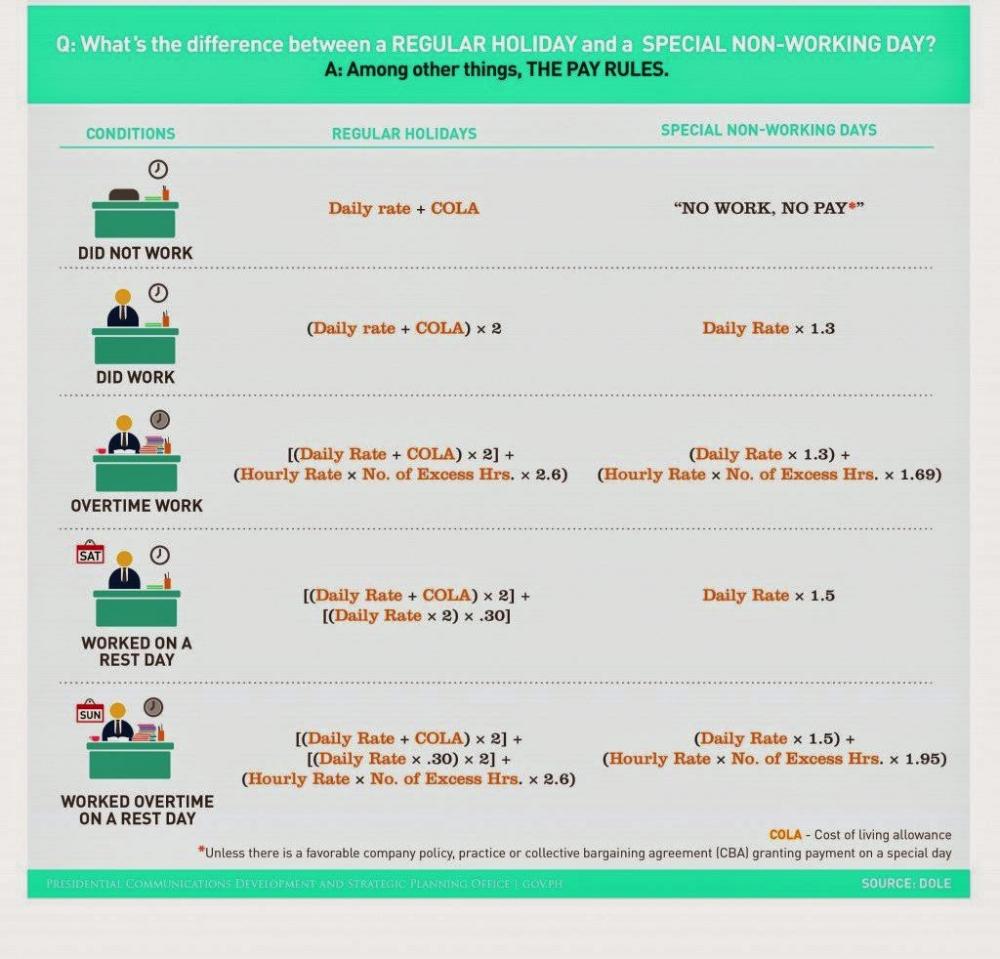
  • [INFOGRAPHIC] Regular Holidays vs. Special Non-Working Days

    I found this while browsing through my Twitter list.

    Note the pay rules for each.

    Check out the original tweet by the Official Gazette PH.

  • A Seafarer’s Cause of Action Arises Upon His Disembarkation from the Vessel

    On 4 February 2010, Khalifa Algosaibi, through its agent, 88 Aces, hired Apolinario as an ordinary seaman to board the vessel MV Algosaibi 42. His employment contract was for a duration of 6 months.

    After passing the required pre-employment medical examination, Apolinario left Manila on 26 February 2010 and embarked MV Algosaibi 42 in Ras Tanura, Kingdom of Saudi Arabia.

    After completing his contract in August 2010, Apolinario was not repatriated to the Philippines, for he directly entered into a new employment contract with 88 Aces’ foreign principal, Khalifa Algosaibi. This new contract with Khalifa Algosaibi lasted until April 2012.

    While on board MV Algosaibi 42 in December 2010, Apolinario suddenly experienced dizziness. As his condition did not improve, he was sent to As Salama Hospital in Al-Khobar, Kingdom of Saudi Arabia where he was found to have high glucose and cholesterol. Apolinario notes that he was given medicine by the doctor and was advised to observe proper diet and avoid stress. After taking the doctor’s advice, his medical condition improved and he was able to perform his work well.

    However, after 2 years, particularly in January 2012, Apolinario alleged that his dizziness recurred, accompanied by the blurring of his vision. On 2 April 2012, he stated that he returned to As Salama Hospital where he was diagnosed to have diabetes mellitus and dislipedemia.

    In 11 April 2012, Apolinario was repatriated in Manila.

    Apolinario claims that he immediately reported to the office of 88 Aces to get his unpaid wages and for him to be referred to the company physician. However, 88 Aces viewed that his repatriation happened because he completed his 6-month Philippine Overseas Employment Administration standard employment contract. Thus it declined to shoulder his medical expenses. Apolinario no longer insisted on treatment and just continued taking the medicine given by the Kingdom of Saudi Arabia doctor.

    Although Apolinario felt well, his illness recurred on 2 August 2013. Apolinario then consulted Dr. Joseph Glenn Dimatatac, an internal medicine physician, who informed him that his illness was indeed diabetes mellitus.

    On 17 March 2015, Apolinario consulted Dr. Rufo Luna, the Municipal Health Officer of the Municipality of San Jose, who declared him to be physically unfit to continue work due to his hyperglycemia. Consequently, Apolinario demanded, albeit unsuccessfully, the payment of his disability benefits from his employer.

    Apolinario filed his Request for Single Entry Approach at the National Labor Relations Commission on 25 March 2015. Then, on 8 May 2015, he filed a Complaint against Khalifa Algosaibi, 88 Aces, and Jocson (Respondents) before the Office of the Labor Arbiter for the payment of disability benefits.

    Respondents, on the other hand, denied liability for the following reasons:

    • Apolinario filed his Complaint 5 years after the completion of his employment contract in August 2010. Thus, his cause of action had already prescribed, not having been filed within the 3-year prescriptive period set by law.
    • Apolinario finished his 6-month employment contract in August 2010 without any medical issue whatsoever.
    • Apolinario actually failed to comply with the 3-day post-employment medical examination requirement.

    RULING:

    RE: Prescription

    Under the standard employment contract of the Philippine Overseas Employment Administration, a contract between an employer and a seafarer ceases upon its completion, when the seafarer signs off from the vessel and arrives at the point of hire.1Section 2, Philippine Overseas Employment Administration Memorandum Circular No. 10, Series of 2010 (Amended Standard Terms and Conditions Governing the Overseas Employment of Filipino Seafarers On-Board Ocean-Going Ships [October 26, 2010])

    In this case, while Apolinario’s 6-month contract may have ended as early as August 2010, he nonetheless was able to sign off from MV Algosaibi 42 and arrive at the point of hire only on 11 April 2012.

    (Significance: A seafarer’s cause of action arises upon his disembarkation from the vessel.)

    As Apolinario’s disembarkation from the Algosaibi 42 was on 11 April 2012, he had three years from the date, or until April 11, 2015, to make a claim for disability benefits.

    Apolinario had requested for a Single Entry Approach2The Single Entry Approach is an administrative approach to provide an accessible, speedy, and inexpensive settlement of complaints arising from employer-employee relationship to prevent cases from ripening into full blown disputes. All labor and employment disputes undergo this 30-day mandatory conciliation-mediation process. before the National Labor Relations Commission as early as 25 March 2015.

    The fact that Apolinario filed his Complaint before the Office of the Labor Arbiter only on 8 May 2015 is of no moment. Since the Single Entry Approach is a pre-requisite to the filing of a Complaint before the Office of the Labor Arbiter, the date when Apolinario should be deemed to have instituted his claim was when he instituted his Request for Single Entry Approach on 25 March 2015. Considering that the expiration of Apolinario’s cause of action was on 11 April 2015, his claim was filed well within the 3-year prescriptive period.

    RE: Disability benefits

    The Supreme Court ruled that Apolinario is entitled to permanent total disability benefits.

    Under the Philippine Overseas Employment Administration Standard Employment Contract, those illnesses, such as diabetes mellitus, which are not listed as an occupational disease are disputably presumed as work-related.3Section 20 (A) (4), Philippine Overseas Employment Administration Memorandum Circular No. 10, Series of 2010 (Amended Standard Terms and Conditions Governing the Overseas Employment of Filipino Seafarers On-Board Ocean-Going Ships [October 26, 2010])

    According to the Court, the effect of the legal presumption in favor of the seafarer is to create a burden on the part of the employer to present evidence to overcome the prima facie case of work-relatedness. Absent any evidence from the employer to defeat the legal presumption, the prima facie case of work-relatedness prevails.

    To reinforce the prima facie case in his favor, Apolinario stated that during the existence of his contract, he experienced recurring dizziness and was diagnosed at As Salama Hospital in Al-Khobar Saudi Arabia to have contracted diabetes mellitus. In fact, while on board the vessel, he was twice sent to As Salama Hospital in Al-Khobar Saudi Arabia for medical treatment. To support his claim, Apolinario presented the medical record issued by the hospital and the different medical certificates of his physicians after his repatriation in Manila stating that he is already physically unfit to return to work due to his diabetes mellitus.

    On the other hand, the Supreme Court found that respondents failed to present a scintilla of proof to establish the lack of casual connection between Apolinario’s disease and his employment as a seafarer.

    The Court stated that had respondents granted Apolinario’s request to undergo a post-employment medical check-up, they could have presented a medical finding to contradict the presumption of work-relatedness of Apolinario’s illness. The post-employment medical check-up could have been the proper basis to determine the seafarer’s illness, whether it was work-related, or its specific grading of disability. Having failed to present any evidence to defeat the presumption of work-relatedness of Apolinario’s diabetes mellitus, the prima facie case that it is work-related prevails.

    Nonetheless, the Supreme Court clarified that the presumption provided under Section 20 (A) (4) is only limited to the “work-relatedness” of an illness. It does not cover and extend to compensability. In this sense, there exists a fine line between the work-relatedness of an illness and the matter of compensability. Work-relatedness merely relates to the assumption that the seafarer’s illness, albeit not listed as an occupational disease, may have been contracted during and in connection with one’s work, whereas compensability pertains to the entitlement to receive compensation and benefits upon a showing that a seafarer’s work conditions caused or at least increased the risk of contracting the disease.

    The Supreme Court noted the medically accepted finding that stress has major effects on a person’s metabolic activity. The effects of stress on glucose metabolism are mediated by a variety of counter-regulatory hormones that are released in response to stress and that result in elevated blood glucose levels and decreased insulin action. In diabetes, because of a relative or absolute lack of insulin, the increase in blood glucose on account of stress cannot be adequately metabolized. Thus, stress is a potential contributor to chronic hyperglycemia in diabetes.

    In this case, to prove that his work conditions caused or at least increased the risk of contracting the disease, Apolinario showed that part of his duties as an Ordinary Seaman in MV Algosaibi 42 involved strenuous workload such as assist in the handling and operation of all deck gear such as topping, cradling and housing of booms; aid the carpenter in the repair work when requested; scale and chip paint, handle lines in the mooring of the ship, assist in the actual tying up and letting go of the vessel and stand as a lookout in the vessel. Apolinario further stated that while inside the vessel for several months, he was exposed to physical and psychological stress due to rush jobs, lack of sleep, heat stress, emergency works and homesickness for being away from his family. From the above enumeration of Apolinario’s duties on board the vessel, he was certainly exposed to various strain and stress — physical, mental and emotional.

    Respondents failed to adduce any contrary medical findings from the company-designated physician to show that Apolinario’s illness was not caused or aggravated by his working conditions on board the vessel. There was also no showing that Apolinario is predisposed to the illness by reason of genetics, obesity or old age. Thus, the Supreme Court considered that the stress and strains he was exposed to on board contributed, even to a small degree, to the development of his disease. Inasmuch as compensability is the entitlement to receive disability compensation upon a showing that a seafarer’s work conditions caused or at least increased the risk of contracting the disease, Apolinario’s disease was thus declared compensable.

    RE: Reportorial Requirement

    While the requirement to report within three working days from repatriation appears to be indispensable in character, the Supreme Court enumerated the established exceptions to this rule:

    • when the seafarer is incapacitated to report to the employer upon his repatriation; and
    • when the employer inadvertently or deliberately refused to submit the seafarer to a post-employment medical examination by a company-designated physician.4Falcon Maritime and Allied Services, Inc., et al. v. Angelito B. Pangasian, G.R. No. 223295, March 13, 2019.

    Here, Apolinario avers that two days after his repatriation to Manila on 11 April 2012, he reported to the office of 88 Aces to get his unpaid wages and for him to be referred to the company designated physician. However, since his repatriation was due to the completion of his six-month Philippine Overseas Employment Administration-approved employment contract, he was told by 88 Aces through Jocson that they could not shoulder his medical expenses. Having been denied to undergo the post medical examination, Apolinario just continued taking the medicine given to him by the doctor in Saudi Arabia.

    Between the two conflicting allegations from Apolinario and respondents, the Supreme Court resolved the doubt in favor of Apolinario. Besides, the factual backdrop of the case supports Apolinario’s allegation that he requested to be referred to a company designated physician. It noted that Apolinario repeatedly experienced dizziness and headaches, and needed medical attention while on board MV Algosaibi 42. In fact, because of his recurring sickness, he was examined twice at As Salama Hospital in Al-Khobar Saudi Arabia and even underwent thorough treatment thereat 10 days prior to his repatriation to Manila. Given Apolinario’s sensitive medical condition days prior to his repatriation, The Court doubted respondents’ allegation that Apolinario did not request to be referred to post-employment medical examination when he arrived in Manila. Apolinario’s medical condition during and after his employment on board lends credence to his claim that he asked to be medically examined by a company-designated physician but he was prevented so by respondents.

    According to the Supreme Court, respondents had the opportunity to refer Apolinario to a company-designated physician, but they chose to escape their responsibility. Between the non-existent medical assessment of the company-designated physician and the medical assessment of Apolinario’s doctor of choice — stating that his disability is permanent and total — the latter evidently stands. Absent a certification from the company-designated physician, the law steps in to conclusively characterize his disability as total and permanent.

    Further Reading:

    • Zonio, Jr. v. 88 Aces Maritime Services, Inc., G.R. No. 239052, October 16, 2019.